



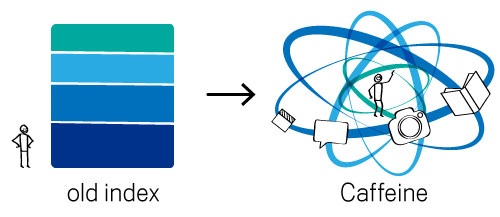
Earlier this week, Google formally announced the completion of its new web indexing system cleverly named Caffeine. According to Google, Caffeine provides 50% fresher results for web searches than its last index and is the largest collection of web content the search giant has ever offered.
Our old index had several layers, some of which were refreshed at a faster rate than others; the main layer would update every couple of weeks. To refresh a layer of the old index, we would analyze the entire web, which meant there was a significant delay between when we found a page and made it available to you.
With Caffeine, we analyze the web in small portions and update our search index on a continuous basis, globally. As we find new pages, or new information on existing pages, we can add these straight to the index. That means you can find fresher information than ever before—no matter when or where it was published.
– Carrie Grimes, Software Engineer, Google
This is great for those of us who use Google to search and find relevant results to our most common inquiries. Results will become timelier, more social and rely more heavily on keyword strings, ultimately providing more useful results as newer content can be indexed much quicker and from a much larger base of sites.
Is your SERP spot threatened?
When Google says “fresher” results, what they’re saying is that ranking principles have not changed, but rather rankings are (and will become) more dynamic, shifting to display the latest and greatest (and, therefore, hopefully best) information as a result of being able to reach deeper and more frequently into the Web.
But what about website owners who have come to rely on the steady ebb and flow of organic traffic that a high Search Engine Results Page (SERP) position provides?
Many website owners who have long enjoyed a top spot, or even a high spot, have suddenly found their sites displaced, resulting in a massive dip in organic traffic. And to make matters even more vexing, the position your site is in this month will likely be different from where you find yourself next month.
Which is not entirely new, right? Anyone well-versed in search engine optimization (SEO) knows that it is a never-ending battle. The difference is, ranking improvements and demotions may happen even quicker than before because content that you and your competitors are creating will have a more immediate impact within the results. So if you thought SEO was a wild ride before, hang on.
Of course, your main goal should be to deliver value to your customers and audience. After all, ranking is only a means to an end. And since Caffeine should do a better job of measuring that value, it might start putting some distance between those who do provide quality content and those who are merely gaming the system.
Caffeine makes it more difficult, although not impossible, for sites using black hat SEO tactics to reach and/or maintain a position at the top of the rankings for long periods of time. And while I believe SEOs will always find new ways to game the system, I think Google has made a step forward in terms of providing better-quality results.
How to get a boost from Caffeine
So if you can’t rule Google SERPs by just throwing up an automated page with repurposed content, what should you do? Here’s my advice to website owners who rely heavily on organic traffic:
- Continually look for opportunities to expand or update the content on your site for improved keyword targeting
- Re-evaluate your current keywords and always look for opportunities to expand and capture more long-tail keywords
- Build a site that contains clean code and a clear site structure
- Look for opportunities to capitalize on social media as real-time results become more integrated with search results
- Monitoring your competitors will be paramount as new content brought in by them will be indexed quicker than ever.
So fresh and so clean
I think this transition to providing “fresher” results was inevitable as competition from Bing and the massive growth of “real-time” information from social networking sites like Twitter and Facebook have created a need for better, faster, (stronger), search engine results. And from a conversion standpoint, I’d argue that this move could ultimately prove to be more beneficial to ecommerce sites that provide high-quality content, because “fresher,” more relevant results also means more qualified traffic.
Of course, cleaner, less manipulated results will have huge benefits to searchers and real, quality sites alike. Remember that both you and Google are on the same mission: provide the right page to the right user. Oh, and don’t be evil.
Related Resources
Search Marketing: Tips on mastering the latest innovations in this mature category
PPC Innovation: How will Google’s new lead capture extension affect your pay-per-click campaigns?
Optimizing PPC campaigns to boost conversions, ROI
Photo attribution: The Official Google Blog

The more pages are indexed according to continuous content the less of a factor black hat SEO will be. This will challenge content writers to write, Tweet, and interact with their audience more; but I think it will level the playing field a little more.
Erick
Interesting. SERPs have always been an exciting thing to tackle. The strategies around it alone are always exciting. I do agree though, even I’ve moved from a heavy SERP focus to factor in more engaging content. Great article.
Whilst the completion of Caffeine has been announced, I’ve yet to notice any significant changes in the SERPs and more worryingly, much of an increase in speed.
Nevertheless, displaying more relevant results for the searcher can only be a good thing, will be a pleasant welcome to see up to date information at the top of the SERPs instead of out of date articles and information from 2000-2006
Great blog post!
I think, that Caffeine can lead to a more real-time web and therefore benefit those that manage to wrap their head around creating buzz in the right channels. Also, it takes the competition beyond the “who writes the most key word stuffed articles”, a technique I really dislike.
Not sure this will change much. I mean, if you were Google, would you really change your serps to accomodate newer web pages that will be optimized for google? This would open the door for more black hat SEO, not less. Links from trusted sites will continue to be the most important part of SEO.
Google has always done a good job of keeping the SERPs fresh and relevant, but I’m not so sure content ‘freshness’ will equate to content quality.
New articles and webpages are not necessarily better (and often worse) quality than already established ones. I do think it’s a good idea to allow faster indexing and more opportunities for rank fluctuation, this should allow more pages to hit high positions and show their quality… but at the end of the day, I think Google just wants to make SEO a more difficult and expensive game to play so more people will SPEND MONEY ON ADVERTISING.
Interesting, but doesn’t Google now do an interest based search results as well? I think I’ve read somewhere that it now remembers what you’ve searched for before – and then alters your search results accordingly to provide what google feels is more relevant info (even if you aren’t logged into a google account)
Either way, seems like dominating serps will become even more of a never ending process than it used to be.
I appreciate the emphasis that Caffeine places on currency and authenticity. I hope that there is not an element of lost impact for long-standing players. That is, I would hate to be punished for providing a strong presence for years versus someone who appeared last week.
Because things change frequently, I can appreciate Google’s work to rank according to freshness. It helps. It would also help to rank content on how trustworthy it is. I hope they will explore more ways to reward trustworthy sites. Like most people, I am overwhelmed to find 10,000,000 experts on every subject. Who do I trust?
SERPs based on a person’s past searches or interests will make it difficult for marketers to see the world as others see it. Such a feature should be configurable by the user depending on how they use search. The idea sounds like a separate kind of search to me, maybe a separate company.
In my humble opinion, this article seems to take some Google general statements then apply assumptions to reach conclusions that don’t appear unwarranted. I could reference a 6 page website that has not changes in 3 years. It has ranked #1 for its most frequently used keyword and will rank top 10 for at least 2,000 relevant keywords. It’s SE referrals have increased since caffeine was launched.
If freshness has any impact on SERPs then it possibly only kicks in when Google has previously stated that “freshness” kicks in. What have others found?
@ John Webster
Hi John, you are correct. This post does take some Google general statements and apply assumptions to reach conclusions. But I wouldn’t rush to say these statements are unwarranted.
There will always be examples of older sites that rank well. The simple reason being that Google’s algorithm doesn’t base its ranking solely on “freshness.” As mentioned in the post, old principles still apply—site age, number of backlinks, trustworthiness with Google all still affect your ranking. And based on your comment, the page you use in your example has been around for at least 3 years, indicating that it has had an opportunity to build up credibility in areas that Google deems important.
Would love to hear what others have found as well.
Thanks for the comment!
Yes, but when I say “Don’t be evil” I mean it.
I wasn’t one of the dolphins caught in the Panda update but I do know some people who were. They’re not evil, either, just trying to get by by building as many sites as possible (which of course means none of them are very good). This is a tough and unforgiving business.