
Archive

Posts Tagged ‘copywriting’

Blandvertising: How you can overcome writing headlines and copy that don’t say anything

January 20th, 2012 2 comments

Great things happen … when you extend your manufacturer’s protection right away!


I recently wrote a blog post about the audacity of hype – how companies can overreach with their advertising claims … and the potential customers who just don’t believe them.

So today, on the flip side, let me address the copywriting that doesn’t say anything at all. Take the above headline, for example. For lack of a better word, let’s call this …

Blandvertising

Blandvertising is a wishy-washy marketing claim. Like the italicized headline above, it wants to mean something … but it just doesn’t mean anything.

Maybe because the marketer didn’t want to have to deal with Legal. Or maybe because the marketing manager or copywriter had an empty text box in InDesign and just had to throw something in there.

This background noise, this elevator music copywriting is a total waste of your marketing budget. If you’re paying for the opportunity to say something, whether with a direct mail piece, a PPC ad, on product packaging, or just on your website … then actually say something.

But what exactly? You’re crazy busy. Perhaps you’re not a writer. And you have an empty text box staring you in the face. What do you put in there?

Through our testing, we have found that …


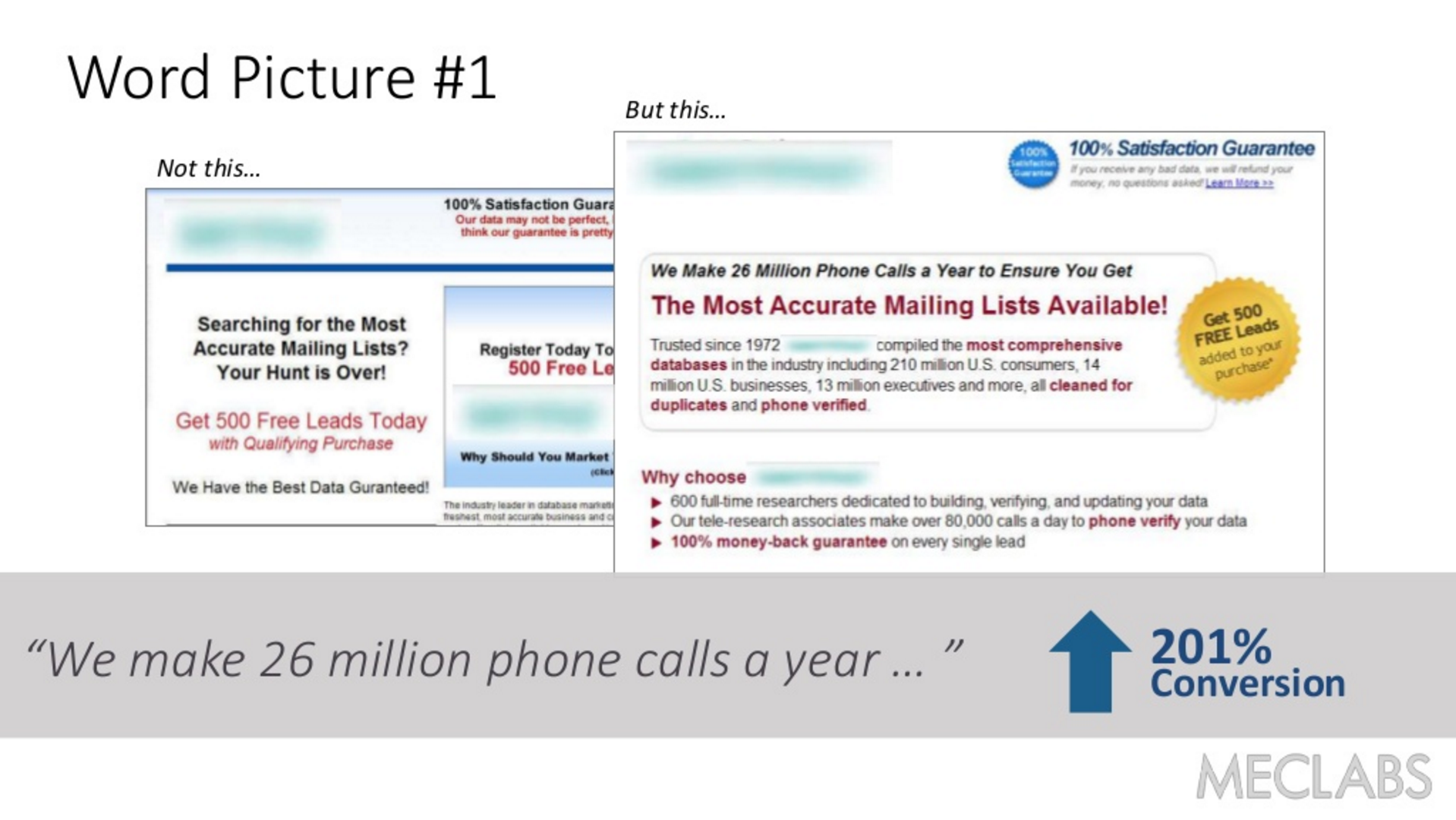
Specificity converts

“We know from our foundational Offer/Response-Optimization principles of ‘clarity trumps persuasion’ and ‘specificity converts,’ that the clearer and more specific subject line — i.e., the one with the ‘15% Off…’ copy — should convert better,” said Bob Kemper, Senior Director of Sciences, MECLABS.

While in that specific quote Bob was focused on subject lines, this principle applies equally well to many marketing media.

So next time you’re staring at the great abyss of an empty text box that needs some copy, increase the specificity of your messages by using quantitative statements, instead of relying on vague qualitative statements, to better communicate value and ultimately generate more response.

To help you out, let me show you a few examples from recent tests …


Before


After


Results

58% increase in conversions

(In fairness, much more than the headline contributed to the lift. You can see the full story at Rapidly Maximizing Conversion: How one company quickly achieved a 58.1% lift with a radical redesign)


Before


After


Results

21% increase in clicks, 272% increase in overall conversion

(See the full story at How to Increase Conversion in 2012: The last 20,000 hours of marketing research distilled into 60 minutes)


Before

First Look at New Products, Technology, and More

After

IADC 2011 – Exclusive First Look at New Products, Technology and More

Results

8.2% increase in open rates

(Read the full story at Email Subject Lines: Longer subject increases opens 8.2%)


Related Resources:

Transparent Marketing: Do your campaigns sound like North Korean propaganda?

Landing Page Optimization: Addressing customer anxiety

This Just Tested: How PPC specificity drove 21% more clicks and cut costs 66%


Transparent Marketing: Do your campaigns sound like North Korean propaganda?

January 6th, 2012 2 comments

I know, I know. Your product is super fantastic. The best in the industry. Perhaps the best ever. In a word – infallible.

Except, well, I don’t know how to break this to you, it’s not. No product is perfect. And not every product is right for every person (while we’re at it, you’re really not that special and there is no Santa Claus or Easter Bunny).

The only challenge is, when you make your offer sound like it’s too good to be true, no one believes you and you’re only shooting yourself in the foot. Let’s look at an extreme example …


Overhyped marketing from the North

According to The Wall Street JournalPyongyang Myth-Builders Step It Up – here is some of the official line from the other side of the Northern Limit Line …

About Kim Il Sung, founder of North Korea: He once made a hand grenade from a pine cone to blow up an American tank.

About his son and successor, Kim Jong Il: When he was born, the sky was filled with lightning and thunder, and a rainbow.

About the new leader, Kim Jong Eun: He is ‘an excellent general who displays the extraordinary talent of hitting the center of the target no matter how many times he fires.’


Your product should not have a cult of personality

OK, that’s obviously ridiculous. So your product might not be mythmaking for the Dear Leader, but, I ask you, are some of these lines really any more believable?

Huge Savings! Exclusive Deals! Limited Time Offer!

70% Off! 80% Off! 90% Off! (this will eventually hit 100% off, right?)

Decision Management Solutions research identifies the ultimate real-time predictive marketing solution requirements (and exhale)


Don’t believe the hype

Your own, that is. Because, frankly, nobody else does.

As Flint McGlaughlin, Managing Director, MECLABS, has said in Transparent Marketing: How to earn the trust of a skeptical consumer, “While this writer has no desire to demean the work of another professional, the Postmodern Consumer couldn’t care less. He actually despises hype and anything else that insults his intelligence.

“He is armed and dangerous. With a single click, he can terminate a company’s opportunity.”

However …

  • If your marketing campaigns (and especially your content marketing) elucidate and don’t obfuscate …
  • If in a hype-filled world, you actually live up to Dr. Philip Kotler’s value-focused definition of marketing – “A social and managerial process by which individual groups obtain what they need and want through creating, offering, and exchanging products of value with others” …
  • If you help your customers find true value instead of grabbing a quick hit sale before they figure you out …
  • And if you focus on serving the customer instead of your own dictatorial ego

… then I was wrong about you after all.

You really are special.


Related Resources:

The Last Blog Post: How to succeed in an era of Transparent Marketing

Transparent Marketing: A slice of honesty from Domino’s Pizza

Transparent Marketing and Social Media: Twitter and Facebook are the new Woodward and Bernstein

11 Most-Tweeted Posts of 2011: Social media marketing, copywriting, email testing and more …

December 28th, 2011 No comments

In 2011, this blog produced 140 blog posts. Hopefully, you found some of those blog posts helpful in your day-to-day marketing work. If you did not, let us know in the comments and we’ll write 140 better ones next year.

Of course, as a marketer, you’re probably one of the busiest people alive and you probably missed a few, if not the majority of, posts this year.

So to catch you up, we sorted our posts by how valuable they were to you (as you and your peers communicated to us via the Twitter button) and created a roundup of the 11 most-tweeted posts in 2011.

Here they are in order of least popular to THE most popular MarketingExperiments blog post of 2011 (and potentially all time).

  Read more…

Headlines on Deadlines (Part 2): How to consistently write effective headlines without working late

December 21st, 2011 No comments

Writing an effective headline takes time. It’s arguably the most important part of your copy, and skimping on the time investment usually produces skimpy results.

When will inspiration strike? What will be your muse? As Douglas Adams said, “Writing is easy. You only need to stare at a piece of blank paper until your forehead bleeds.”

Unfortunately, as a marketer, you don’t have the time (or goatee) of a creative writing master’s student. However, you do have to write.

Your goal isn’t different though. It’s not art; it’s income. So you don’t have time to produce perfect headlines for every piece of copy you generate. And you can use a reproducible methodology that gets you in the ballpark of effective, conversion-driving headlines (and testing will take you the last mile).

So the question is this: how can you (a time-strapped marketer) write effective headlines in a relatively short amount of time?

In part one of this series, I proposed a methodology for getting headlines done quickly. It involves a methodology for evaluating and refining raw headline drafts. When you have a method for a task, it automatically becomes more manageable. In this case, you can write headlines the same way a plumber fixes a pipe.

However, I only gave you the first part of the methodology for evaluating your headline drafts.

For those who didn’t read Monday’s post, let me quickly fill you in.

I first wrote three headlines for our December 7th Web clinic and chose one to evaluate:


The Year in Optimization: The top insights and transferrable principles from 121 tests in 2011


In Step 2, I underlined the noun phrases as these generally communicate the core value or what the audience will get.

Then in Step 3, I evaluated the force of the noun phrases around four key elements:

  • Appeal: How attractive is the phrase to our ideal reader?
  • Credibility: How believable is the phrase?
  • Exclusivity: Can anyone else credibly claim to have what is offered in the phrase?
  • Clarity: How easily can the reader understand it?

This second post highlights the part of the methodology for refining your headlines into a finished product.

So without further ado, I’ll continue with Step 4:

Read more…

Headlines on Deadlines (Part 1): How to consistently write effective headlines without working late

December 19th, 2011 2 comments

There’s a lot written about headlines. Most of it is fluff. A little of it is true, or at least based on solid evidence. But I don’t think I’ve ever read anything that actually helps marketers write effective headlines in the fury of the daily grind.

When you’re working on a project or a campaign, the last thing you need to do is sit around and wait for the creative muse to strike. You need to be able to write headlines (and copy for that matter) quickly and efficiently.

This post is my attempt (with a lot of help from Flint McGlaughlin) to give you a methodology to diagnose and solve the problem in a workman-like fashion, just like a plumber or mechanic would, for example.

After running several headline tests (one example), MECLABS has developed a methodology for writing headlines.

And unless you are a headline genius and you can nail your headlines on the first try every time, a methodology is exactly how you can make your headlines consistently successful in a timely manner.

So how can you write an effective headline on time, every time?

To answer that question, I sat down with our Managing Director, Flint McGlaughlin and worked on a few headlines for our previous Web clinic. The process he laid out is essentially four steps and based on the discoveries we’ve made through our research.

Read more…

Value Proposition: How headlines helped lead to a nearly 29% conversion boost

August 12th, 2011 1 comment

In college, I had a journalism professor who said, “Make your headline twice as powerful as the event.” This is sage advice if you’re covering the Kardashian beat for a weekly tabloid, but it doesn’t seem to directly apply to today’s marketers.

(Apologies to any members of the Kardashian marketing team who may have been offended by the previous comment. You’ve done a terrific job promoting whatever it is that made them famous.)

But maybe it is applicable, after all. Despite a marketer’s goal of thoroughly conveying value on a landing page through well-crafted body text and use of images, there often remains a need for a powerful “hook” to further motivate a potential customer.

(Just recently, MarketingExperiments held a Web clinic that covered this very subject.)

When it comes to landing pages, one would think that it would be much easier to get users to convert, as they have already expressed a certain amount of interest via search or email clickthrough. But these users still need to be quickly reminded of why their clicks landed them there in the first place.

In the following test, you’ll see that a continuation of the value proposition was deftly handled with the addition of a few short, powerful words, alongside a much-needed change in the way our partner asked for information. Read more…