

Archive

Posts Tagged ‘Facebook’
Daniel Burstein

Social Media Case Study: Facebook plus integrated marketing helps raise $950,000

Daniel Burstein June 14th, 2010

Recently, I wrote about a case study that included excellent use of integrated marketing and social media – Facebook Case Study: From 517 to 33,000 fans in two weeks (plus media coverage). The MarketingExperiments community of marketers wanted to get a deeper look at the details, so I figured, why not go straight to the source?

Brenna Holmes, a senior online account executive and strategist at Adams Hussey & Associates (AH&A), was the digital brand strategic advisor on this campaign for her client, the California State Parks Foundation (CSPF). I asked her many questions from our audience along with a few of my own…

Let’s start with your role in this campaign. Social media operations is a huge challenge in itself. We’ll get to what you did in a moment. But first, how did you get it done?

Brenna Holmes: In the case of this urgent campaign, not only did I serve as an advisor, I also helped with implementation for all things social – optimizing their existing Facebook fan page with the custom welcome tab and many personalized Facebook Markup Language (FBML) widgets. Later in the campaign, I started and managed their Twitter account.

CSPF is a very small and tightly knit organization. Their Director of Membership, Greg Zelder, and Director of Communications, Jerry Emory, are my daily contacts and it was (and is) in collaboration with them that we got a full-scale multichannel campaign up and running within one week of learning of the Governor’s proposed budget cuts.

The first thing that catches my eye about this case study is the quick, large Facebook fan page growth that led to positive media stories. But when you explore this success a little deeper, it’s not just a case for social media marketing, but integrated marketing as well. Can you give us more details on how you used multichannel marketing?

BH: At AH&A, we LOVE multichannel integration. As a direct mail fundraising shop that has expanded to include pretty much in-house everything (online, telemarketing, creative, production, and analytics), practically every campaign we plan has multichannel components.

And this case was no different. CSPF had been a direct mail and telemarketing client of ours for many years, but 2009 was the first year that my department began working with them.

Actually…the budget cuts issue made us start our contract a month early! Within 48 hours the organizational website was redesigned to accommodate an Action Center, daily homepage updates, graphic social media sharing links, and embedded YouTube videos made by both the organization and passionate supporters.

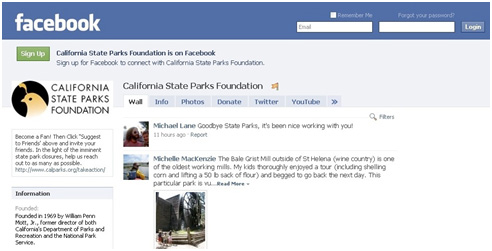
The Facebook “Friend Get a Friend Campaign” was launched the Tuesday after Memorial Day weekend, May 26, (which is when the Governor’s proposal was released) via an update to CSPF’s original 517 fans.

The update explained the imminent threat parks were facing and put a deadline – Friday, May 29 – and a goal – 5,000 fans. “This year’s cuts are ten times as bad, so we need ten times the fans on Facebook.”

Once supporters became fans, they were presented with an action item asking them to visit CSPF’s site to sign an email petition to the California legislature and Governor Schwarzenegger. We also set up and managed CSPF’s paid online advertising on both Facebook and Google to drive supporters to become fans and/or sign the petition. All this Web outreach was supported by an aggressive email petition and donation campaign to the house list and partner organizations in California.

The online campaign was mirrored in direct mail with three “urgent grams” that were in people’s mail boxes by the end of the week – one to high-dollar donors ($1,000+), one to all other members, and one to prospects. All three pieces netted funds and raised more than $200,000 in just over a month. Telemarketing was also excellently leveraged – existing campaigns were halted and new scripts were implemented, raising more than $88,000 in the first two weeks of the campaign.

That whole week in May, Foundation staff members were being interviewed and the story was picked up by SF Gate, Huffington Post, LA Daily News, Frommers, etc. They even made it onto Digg! By early June the Facebook growth was being referenced in mainstream news articles and on other environmental and California-based nonprofit Facebook pages.

Were these other channels used to primarily promote Facebook over the CSPF website?

BH: Facebook was never promoted over the website. Facebook promotion was always either in conjunction with site promotion (general “Find Us on Facebook” links) or as a secondary ask (“Thanks for taking action! If you are on Facebook, click through to join the conversation”).

Other than the specific “Friend Get a Friend” outreach on Facebook and some of the Facebook ads, we were primarily driving supporters to the online Action Center to sign the petition, make donations, and later on, print Save Our State Parks signs and upload their photos from the SOS weekends of action.

Join CSPF

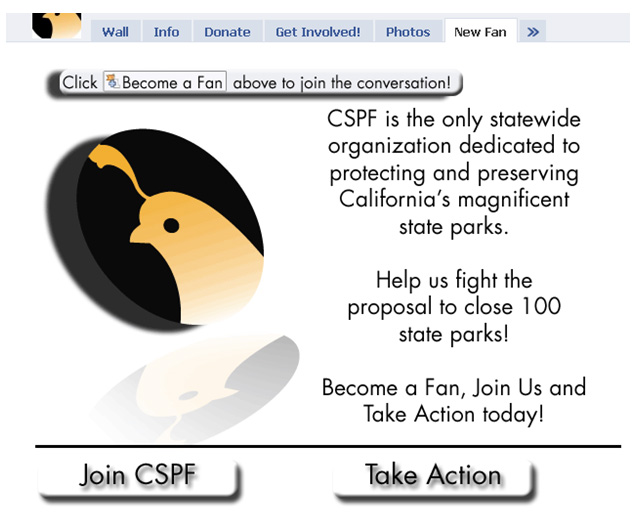
When people visit the CSPF Facebook fan page for the first time, they see a pseudo landing page that encourages them to become a fan or go to the CSPF website. I love the landing page, it’s a very clear way to communicate with your audience about the actions you’d like them to take (instead of just showing your wall to new visitors). Why did you decide to send users to a pseudo landing page instead of the wall?

BH: I’m a big fan of introductions, and maximizing the personalization of user experiences online. It’s a pet peeve of mine when sites (Facebook or other) don’t recognize that I’m new to the site.

So much of the online experience can be controlled from the backend to give a more customized experience. In my opinion, it would be silly to not take advantage of that with something as simple as a welcome tab.

We are trying to put the most efficient but comprehensive view of CSPF out there so people can absorb it in the seven seconds we have before they decide to click elsewhere. A cluttered (or worse barren) wall just doesn’t give the right first impression in my opinion.

And the Facebook landing page doesn’t solely encourage them to become a fan, it gives them other options as well.

There are three asks. This allows supporters to choose how they want to interact with the Foundation. The easiest is, of course, to “Like” the page. Then if they want to do more they can take action or join. The vast majority simply “Like” the page and move onto the “Wall,” but we have seen some petitions and new memberships coming in from these source-coded links.

This campaign helped raised several hundred thousand dollars for CSPF. (Congratulations!) How much came through Facebook, and how much came because of the other channels you used?

BH: Unfortunately we weren’t as proactive in source coding all the links on Facebook as we should have been from the very beginning, so the majority of donations do not show as coming from Facebook during that first burst of activity. However, we do know that 60% of our page connections are self-professed annual members.

In late July/August, we launched a social-media-only campaign promoting the Frequent Visitor membership level ($125 to get an annual parks parking pass) on Facebook and Twitter. Social media allowed us to quickly take advantage of the Parks Department halting annual pass sales for almost two weeks. In that campaign, CSPF gained over 700 new members from social media at the $125 level.

I can also tell you that while the entire integrated campaign earned $950,000, almost $300,000 was raised online and 46% of that came from supporters new to the e-file (either joining as annual members or by giving non-membership issue-based gifts). The e-file also tripled in size as the fan page grew and paid membership grew by 10% in the first two months.

We are much more meticulous about this now and see a steady stream of new memberships, renewals, and issue-based gifts coming in from both Facebook page promotions and the Facebook ads. (Stay tuned for this November’s  Yes For State Parks ballot issue get-out-the-vote work on Facebook.)

What was the budget and team size? Social media seems very labor intensive, very manual.

BH: The online team size was only four of us – me, my vice president for strategic brainstorming, along with Greg Zelder and Jerry Emory at CSPF.

CSPF is on a monthly retainer with us, which includes all work except creative development. We have a larger offline staff that works closely with CSPF to get all the other pieces rolling and now CSPF has added another Web person internally to help out, but during last year’s campaign it was all hands for Greg and me in getting the online pieces up and running and properly maintained.

Social media is labor intensive, but if you have an urgent issue like this one, you drop everything to get it done and done as well as possible the first time around.

What is your follow-up plan for all these new Facebook fans that you have engaged?

BH: I’ve been managing the fan page for over a year now and it continues to grow. CSPF has, on average, a 15.5% month-over-month fan “connection” growth.

CSPF’s Communications Director is very hands on with the content generation and they post at a minimum of twice a week – a “feel good park story” every Tuesday and every Thursday there is a post for the new World’s Best Bike Commute blog that chronicles Jerry’s bike commute across the Golden Gate Bridge.

Greg and Jerry are also very good at posting from their mobiles to keep the page updated with pictures and information from the many live events CSPF holds throughout the year. Ideally I’d like to see a daily update to Facebook, but current staffing constraints at CSPF won’t allow for it. We are currently also working on some fun new content that will only be viewable after supporters “Like” the page.

How much are Facebook fans really worth? Are they very valuable? Or do they just “Like” something because they saw that their friends did?

BH: We find CSPF’s fans VERY valuable, whether they are the active donors or not, many are very outspoken evangelists for the cause. We are actually undertaking a much more robust tracking regime to identify the most engaged Facebook connections so we can do some additional personalized outreach.

Lately, the words Facebook and privacy seem to go hand in hand…

BH: We haven’t had any issues regarding privacy so far. Everything we do is on an opt-in basis and we are very proactive in answering fan questions – even going so far as to help a fan organize her newsfeed content so as to not be “overwhelmed” by our updates.

There are now a plethora of invites to social causes on Facebook. How does one cause really stand out from another?

BH: This is no different on Facebook than in other direct marketing media. Donors and activists have more choices of where to spend their time and money now than ever before. You stand out by staying engaged and listening to your base. Encourage them to be part of the process and they will extend your voice a thousand times over.

Can for-profit marketers use the same tactics you describe?

BH: I think that many of the tactics are the same whether the organization is non- or for-profit, and we “steal” concepts from commercial organizations ideas all the time. Typically the defining issue is cost, since corporations tend to have larger marketing budgets than nonprofits they could conceivably get even more value from social media like Facebook.

For the budding social media marketers out there… what applications have you found to be most valuable in engaging Facebook users?

BH: Custom FBML wall widgets and tabs are a must – like the welcome tab and our Get Involved menu of options. If you have a blog, sync it up with the Notes RSS. Sync your YouTube uploads and add as many of the newly released social plug-ins to your website as feasible. You want to engage supporters where they already live online.

I originally found this case study in the brand new Social Marketing ROAD Map Handbook. If you’re looking to improve your social media marketing, you might benefit from the Handbook’s case studies (in addition to the one I covered above, there are ten more in the Handbook).

Related Resources

The MarketingExperiments Quarterly Research Journal, Q1 2010 (Social Media Marketing begins on page 51)

Social Media Marketing in Four Steps

Develop Your Social Marketing ROAD Map Strategy

Research Topics, Social Media

Daniel Burstein

Facebook Case Study: From 517 to 33,000 fans in two weeks (plus media coverage)

Daniel Burstein May 26th, 2010

OK marketer, put yourself in these shoes (they’re more like boots actually). Your state government is facing massive budget shortfalls. Teachers are being laid off. Draconian cuts to vital public services are being announced left and right. And amid this tumult, you are the one tasked with using your marketing prowess to stave off disaster itself.

The above paragraph probably makes you feel better about your own challenges, but think for a second…given the above situation…and very little resources…what would you do?

Social media marketing for a social cause

At the end of May 2009, the California State Parks Foundation (CSPF) found itself in this very position after learning about massive cuts in state funding that threatened to close 220 California state parks.

In response, this nonprofit organization quickly launched a multichannel effort with its agency, Adams Hussey & Associates, that included direct mail, telemarketing, email, and social networking. I want to focus on that last part for this blog post. Because what amazed (and impressed) me the most was that CSPF used Facebook to shape the larger conversation about this topic.
Facebook

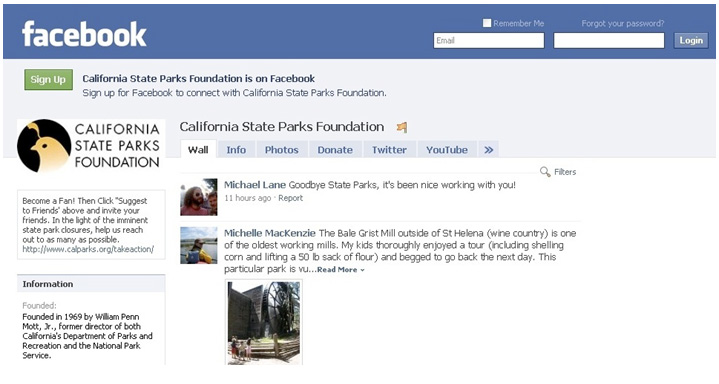
Before I get to that, let’s look at how CSPF used Facebook. They optimized their existing Facebook fan page to promote awareness, discussion, and (hopefully) attract new activists and members. “Find us on Facebook” language and graphics were featured in every email and all over the site.

The “Friend Get a Friend” campaign launched on Tuesday, May 26, on Facebook via an update to 517 fans – “This year’s cuts are ten times as bad, so we need ten times the fans on Facebook.”  The update explained to recipients the imminent threat parks were facing and set a deadline and a goal – 5,000 fans by Friday (May 29).

The second Facebook update was sent on Monday, June 1 at 12:12 p.m. PST, stressing a 24-hour deadline and asking for fans and petition signatures. The California budget committee was scheduled to meet on June 2, so media coverage was at its height.

The Facebook factor shapes the conversation

“The California State Parks Foundation, the lead public organization advocating keeping the parks open, had its fan base on Facebook increase from 500 to 33,000 in the past two weeks, reports Jerry Emory of the Foundation.”

– Tom Stienstra, San Francisco Chronicle, Sunday, June 21, 2009

Now this next part is truly impressive. With just two updates on Facebook (and in all fairness very smart cross-promotion through other channels), CSPF created a proof point for keeping the parks open, helping them meet their “promote awareness” goal.

That’s right, the Facebook campaign itself actually entered the public debate. The massive growth of this fan page caught the media’s attention and was mentioned on several TV news spots and in national news articles. They took advantage of a timely and newsworthy story (the California budget cuts were all over the news on- and offline) and created a talking point to meet their communications goals (several news oulets mentioned the Facebook growth as evidence of a grassroots swell).

As mentioned in the beginning of this post, raising awareness wasn’t their only goal. So let’s take a look at some of the other success metrics. Those two simple Facebook updates (aided by the cross-channel campaign) have helped raise several hundred thousand dollars in nonmember, one-time gifts.

In addition, CSPF more than tripled the size of its email list and acquired many new activists that are being converted to donors online and via the telephone.

CSPF is routinely using social media now. A subsequent Facebook and Twitter promotion gained 285 new members in four days, and their Facebook page has now grown to 54,000 fans.

Other success metrics were a little harder to meet. While California’s budget that was passed at the end of July 2009 did not close the originally proposed 220 parks, budget cuts forced nearly 150 to partially close or reduce services.

What you can learn from this case study

Nonprofit organizations are a natural fit for social media campaigns. People (who believe in your cause) want to help, often don’t want to expend much time or money, and want to look good to their friends, family, and social network. A social media campaign lies at the nexus of these three motivations. And, most importantly, it gives your fans an easy way to act.

Of course, the benefit isn’t limited to non-profit corporations. To wit, the Pepsi Refresh Project uses social media to leverage those same motivations. And this isn’t just a side project for Pepsi. They made a strategic decision to use a social media activism campaign as their main 2010 marketing push…instead of the Super Bowl. This is the first time in 23 years that Pepsi has not advertising during the Super Bowl.

So what can you learn from CSPF? When creating a social media campaign, keep a few important principles in mind:

  • A tight deadline always spurs action online.
  • When supporters can get instant feedback on the effects of their efforts (seeing fan numbers grow) it makes them even more motivated.
  • The best campaigns cross pollinate. CSPF didn’t just use Facebook. It also used direct mail, telemarketing, and email in a tightly integrated fashion, including a custom URL for the Facebook fan page. Even better, add other social networking platforms to the mix, such as Twitter.
  • Be clear. While social media has grown explosively, not everyone you reach will be clear on every convention of every social media platform (which are constantly subject to change). As opposed to showing first-time Facebook fan page visitors the default “Wall” tab (which has no clear call to action), CSPF created a pseudo “New Fan” landing page that included three simple buttons:
    • “Click ‘Become a Fan’ above to join the conversation!” (Please note, as of last month, Facebook replaced its “Become a fan” terminology with the “Like” button)
    • “Join CSPF”
    • “Take Action”

    Join California State Parks Foundation

  • Institute back-end tracking on clicks and conversions to determine where supporters are coming from (this is one thing CSPF would do differently next time).
Mapping an effective media strategy

I found this case study while perusing an early draft of an upcoming book from MarketingSherpa. To read the entire case study, along with ten other case studies from leading companies and 27 real-world examples of what works, order your copy of the soon-to-be released Social Marketing ROAD Map Handbook: A method for mapping an effective social media strategy. If you do so by May 28th, you’ll save $100 and get a free bonus gift.

I want to thank Lead Author Sergio Balegno for letting me take an early look at his research, even though he was still editing it as I poked around. And full disclosure: While Sergio and I are not related, MarketingExperiments and MarketingSherpa are sister companies.

Related Resources

The MarketingExperiments Quarterly Research Journal, Q1 2010 (Social Media Marketing begins on page 51)

Social Media Marketing in Four Steps

Facebook and Omniture: A welcome step in social media measurement

Please Be My Friend: Taking the first step beyond just being on Facebook

Develop Your Social Marketing ROAD Map Strategy

Research Topics, Social Media

Boris Grinkot

Please Be My Friend: Taking the first step beyond just being on Facebook

Boris Grinkot March 15th, 2010

Afraid you’ll be the last brand picked for the kickball team? Worried you’ll throw a big party and no one will come? Sometimes it can feel like social media marketing is another trip through middle school.

The greatest social media challenge marketers say they face is getting their target audience to engage and participate. According to MarketingSherpa’s 2010 Social Media Marketing Benchmark Report, 64% of marketers consider it a very important challenge to achieving social marketing objectives.

Translation: I’m a new kid in a new school and I’m worried no one will be my friend. So let’s take a look at a few Facebook beginner ideas…

This post is unusually tactical for me. I am assuming you already have a social media objective and strategy. You know WHY you need Facebook fans, and you know what to do with them.

When all you have is a hammer, everything looks like a chance to send email

The knee-jerk digital marketing tactic is: hey, let’s send a note to all of our friends.

Sending email to your list is easy, but it’s another piece of spam that will get you unsubscribes. Just because you just embraced Facebook doesn’t mean that they did as well.

Instead, make it a reasonably distinct part of your site and whatever regular email you are already sending out to an opted-in list. People that are already on Facebook will recognize it easily. Don’t waste effort on trying to create new Facebook converts (unless your name is Mark Zuckerberg).

For a true friend, look a little deeper than your list

FriendsI would suggest deeper-reach strategies, starting from understanding your target audience and getting involved in related Facebook Groups. Through meaningful conversation, you can introduce them to your Page (or Group).

Facebook makes relevance fairly easy, if time consuming. Learning about both individuals and groups is naturally available through Facebook content. You can read wall posts, bios, etc.

This means dedicating some marketing or business development human resources to the project (the second biggest challenge according to MarketingSherpa, with 56% of marketers considering it very important). After all, relationships require time and effort.

Active, but measured and judicious participation with the objective of creating interest is what will net you a loyal following.

However, don’t neglect the narrower tactics of contests, special coupons or exclusive deals for your Facebook fans. While these incentives will on average create a less loyal following, their net effect can be very positive.

Understand what Facebook functionality will naturally (and free of charge) carry your message

In social media in general (and on Facebook in particular), retention and new member generation are very tightly related. Every time someone comments in your Page, it is reflected in their wall and visible to their friends, who can then learn about the group and join (individuals may change their settings, but this is the default option and happens most of the time).

You should look to all Facebook features that trigger visibility in people’s News Feeds. For example, creating events will push your Page into the News Feed of those that sign up for them. If you create a Facebook application, installing it (and some updates – wouldn’t you want to be another Farmville!) will generate a visible News Feed post.

There are other more creative tactics (may or may not apply to your Page depending on the tone), where you can invite people to tag themselves in an image, say, of personality types, etc.

Good luck. And let me just remind you of your Mom’s advice on the first day of middle school (assuming your Mom was a marketer). You’re a likable brand, don’t send out desperate notes for friends. Just go out there, be yourself, engage in the activities you love, and you’ll be the most popular brand in school.

Internet Marketing News

Boris Grinkot

Facebook and Omniture: A welcome step in social media measurement

Boris Grinkot March 3rd, 2010

To the detractors, Facebook advertising only works for dating sites (and perhaps online degrees). As we demonstrate with the MarketingExperiments Conversion Heuristic, motivation is the most important factor influencing the probability of conversion. And the detractors would claim that most people who visit Facebook are motivated by one thing and one thing only.

Other marketers are happy to jump at any social media marketing opportunity. To them, Facebook is one big opportunity that they’re just trying to find the right tactics to embrace (of course, it might help to wipe the dollar signs out of their eyes first).

Whatever works

MeasureI’m a pragmatist. I’ll leave my personal biases at the door any day in favor of solid metrics combined with scientific experimentation that shows what really works.

Social media measurement dreamers like myself may have a new champion. Omniture (recently acquired by Adobe for $1.8 billion) will announce an expansion of its partnership with Facebook in a keynote address today at Omniture Summit 2010.

Omniture is going to expand its existing search management solution, and its SearchCenter Plus customers will now be able to manage and compare their spend on search engines and on Facebook in a single tool. Online Marketing Suite 2.0 will include Facebook social media optimization, integrating Facebook ad management with Omniture® SearchCenter®.

This unified reporting will help marketers more efficiently understand and respond to ad ROI (and perhaps move from tactical to strategic use of social media marketing).

What gets measured gets done (better)

Omniture’s powerful analytics and testing tools have provided users with reliable reporting and experimental implementation. (Disclosure: MarketingExperiments provides Omniture SiteCatalyst® and Test&Target® consulting and integration services alongside its own optimization and experimental design expertise.)

Detailed demographic and engagement data provided by Facebook’s login-required environment will further help advertisers position their message in front of the right audience. On the practical side of optimization, the ability to use this data is critical to experimental design (understanding performance on segment level), and the automation already provided by Omniture SearchCenter will help roll out tests on Facebook placement faster in the same convenient interface with search ad management.

Will Facebook become more attractive to major marketers?

This is an important step by Facebook to become a more mainstream publisher, opening it up to Omniture’s substantial customer portfolio of major B2B and B2C brands. Tighter Omniture integration brings additional legitimacy to Facebook as a marketing channel, whose power as a social media network has been as business-ambiguous for major ad spenders as it has been popular for tween marketers.

For optimization professionals, this also signals a significant opportunity to gain greater insights and deliver more relevant messages to target customers.

How do you use social to make money? Respond to the discussion in our LinkedIn group or drop us an email. We’ll feature the best tips, techniques, and practices in a future blog post, so make sure to include any info (Twitter handle, website) that you’d like to promote.

Analytics & Testing, Internet Marketing News, Social Media

Keeping it real … fake: Social media marketing “don’ts”

Peg Davis April 3rd, 2008

I got a shiny, snailmail brochure today touting a famous research organization’s upcoming workshop. One track offers expert advice on social marketing to “Generation Y.” According to the blurb, selling to this audience requires a “non-traditional approach” that includes “adding YouTube and Facebook to your marketing mix and leveraging user-created content.”

Yawn. It sounds so 2006, I’m already asleep.

1571468887_2aceebdd2b_m.jpg As I said in an Oct. 2007 blog post, if it gets to be 2008 (Mr. or Ms. CMO) and your product isn’t in the top 10 search results on Baidu, embedded in South Korean social networks, wrapped around a Brazilian YouTube video, certified carbon neutral, and bookmarked on a Google phone, better get out the cardboard box and start packing your stress ball.

Yet I’m sure hundreds of CMOs will shell out thousands to attend the yakfest, hoping to gain an edge and keep their jobs.

Why does it seem that all of these events are led by Baby Boomers who’ve never skated, surfed, played Tekken 6, or shopped at Karmaloop? I say spend your $2,000 to come on down to Jax Beach and holla at these kids surfing by the pier on spring break instead.

According to the South by Southwest interactive festival Web site, a similar panel at that conference discussed and nominated “ten terrible ad campaigns that abused the ideals of people-powered media.” The campaigns the panelists roasted included:

• Businesses pretending to be bloggers.

• Businesses pretending to be journalists.

• Businesses pretending to be “Joe Blow” in order to flog their products in blog comments.

• Bloggers and vloggers who turn out to be paid floggers.

Trouble is, the panel voting on “The Worst of the Worst in Social Media Marketing for 2007” included reps from companies that oh-so carefully arrange for product pitches on blogs.

As Jack Nicholson said, “My mother never saw the irony in calling me a son-of-a-bitch.”

My advice to those who want the scoop on social media and reaching the elusive GenY:

#1: Don’t lie.

#2: Don’t have others shill, lie, and pretend to be authentic for you. You will be discovered, and you will probably regret it.

#3: Be authentic. If you are a zillion dollar global leviathan, own it, be it, learn to love yourself. Don’t try to be something you’re not. It’s as repelling as grandma wearing Zoë Bikini. You don’t want to see it, and neither does GenY.

Did any of the companies mentioned in this blog (except of course my fulltime employer, MarketingExperiments) pay me for it? Not a chance.

For more on this subject, check out the MarketingExperiments Creed – our attempt at an in-house reminder to keep it real. And let us know if you’ll be dropping by the beach. Our own GenY crew just got a new grill and they’re waxing their boards for these killer waves.

Marketing Insights