



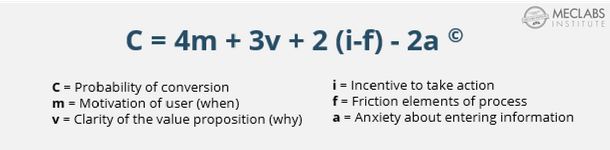
Bob Walker, a frequent clinic attendee, recently emailed us a great question about Friction and Anxiety in the context of the MarketingExperiments Conversion Index, c = 4m+3v+2(i-f)-2a, where “f” stands for the element of Friction in the conversion process and “a” stands for Anxiety …
Here’s what Bob wrote us:
“I’ve attended a number of your free webinars and hope to enroll in some of your courses in the near future. But I have one question that is vital to something I’m working on right now. In the context of your Conversion Index, what’s the difference between Friction and Anxiety? I’m having trouble getting a sense of where one begins and the other ends. It seems to me like friction causes anxiety, rather than it being a separate entity. Thanks!”
Both have a psychological basis. As Dr. McGlaughlin would say, conversion takes place in the mind, not on the page.
For the purposes of the MarketingExperiments testing methodology, Friction is defined as a psychological resistance to a given element in the sales or sign-up process. Anxiety is a psychological concern stimulated by a given element in the sales or sign-up process.
First, Friction. The resistance.
Friction is “the aggravation factor.” One of the most effective ways to increase conversion is to decrease resistance and aggravation. In the most basic terms, we reduce options (but not too much). We reduce length (but not too much). We reduce difficulty (but not too much).
For example, we would usually start by testing a reduction in the number of fields a prospect has to fill out. We would recommend not asking for any more information than absolutely needed at any point in the process (whether that is sales, subscription, donation). We’d attempt to overcome any remaining Friction by offering the ideal Incentive—an appeal—to complete the conversion sequence.
Now, Anxiety. The concern.
Anxiety is “the security factor.” It can be more lethal to conversion than Friction, because while a highly motivated person will put up with a lot of aggravation to get what they want, concern about loss is almost always greater than the desire for gain.
Think about those emails saying you’ve won the UK lottery. What an ideal Incentive! All you have to do is give this official looking organization just a few details: your social security number, your bank details, etc. Virtually no Friction there, but lots and lots of Anxiety. If you don’t experience any Anxiety when giving strangers your vitals, you’re not a normal customer! One of my favorite quotes from Dr. McGlaughlin is, “Trust is the ultimate remedy for Anxiety.”
Which specific techniques have been shown to relieve Anxiety? We teach the Anxiety Relief formula in the Landing Page Optimization course, which is a great foundation for anyone truly interested in becoming a Landing Page Optimization expert, but meantime I would suggest reading this research brief specifically related to Anxiety: Optimizing Site Design: Eight Ways to Increase Site Conversion by Reducing Customer Anxiety.
Of course, there are myriad problems with most Web sites that aggravate both Friction and Anxiety, and we’ll continue testing both our current techniques and new ones in our efforts to overcome these twin value inhibitors.

So, if I understand correctly: friction is “not want to” and anxiety is “I’m afraid to”?
Exactly: Friction causing-elements bug you. Anxiety-causing elements scare you.
As a company (CapitalSolutionsBancorp.com) who only lends money to B2B companies, we are obviously concerned with the quality of our leads.
Sure, I can get rid of all resistance and anxiety, but I still have to highly qualify the prospect before they click on the ad and before they complete our form.
We use single, no-navigation, landing pages for our PPC. And since we lend money, it is extremely easy to hit conversion rates in the 30s , 40s and 50s. But I don’t want that. It’s my goal to give as much “good” anxiety as possible without providing any “bad” anxiety. It’s very difficult. Our ads are nearly all qualifying language and still people don’t read them and click anyway. As you can see, our problem lies at the Google Ad itself because once they click, we pay. Any ideas on producing good anxiety at the ad level? 🙂
Thanks,
Rob
An excellent question, Rob.
I asked Director of Channels Research Aaron Rosenthal for his opinion, and here’s what Aaron suggests:
“Test breaking the process up into two steps. Qualify them after collecting the lead.
“The first step should focus on capturing the greatest number of leads by requiring the minimum amount of information from a visitor.
“Now that you have captured the maximum number of leads, the next step is to qualify those leads. During this step you are going to ask all the “resistance and anxiety” producing questions you removed from the first step.
“What this will do is allow you to do is segment your leads and prioritize your response according to the number of steps they complete.
“Depending upon the number of leads that complete the second step, you may even want to add additional questions to further qualify them.”
I also asked Managing Editor Hunter Boyle for his expert opinion.
Hunter suggests split testing some of the “anxiety producing language” from that second step by inserting it right into your PPC ads, measuring how many more qualified leads you get vs. the unproductive clicks.
Peg,
Thank you much for your response. Aaron’s comment was helpful, but I don’t believe applies to this situation. We aren’t interested in nurturing leads. And by opening up the gates of the first step, we will just be paying more for more unqualified leads. The goal is not to pay for the clicks in the first place…too many people want money.
On the other hand, Hunter’s comment is valid for our situation. And this is in fact what I did. Except for the keyword in the headline, the entire ad is anxiety producing, like “No Construction/Real Estate. No B-to-C, Only B-to-B”, and etc. They are horrible ads but they do their job well.
I have not split tested the the anxiety language however. That’s a great idea.
Thank you again.
Rob
Good article. I often think that subjects like this have a lot of undefined words and ambiguity. It’s nice to see someone making the effort to draw clear and measurable lines to distinguish a pair of concepts.