

Archive

Posts Tagged ‘PPC’
Austin McCraw

This Just Tested: How PPC specificity drove 21% more clicks and cut costs 66%

Austin McCraw June 30th, 2010

It has been a while since we have published Pay Per Click (PPC) ad testing. Lately, it can seem like PPC has taken the back seat to topics like social media and mobile. However, PPC remains an integral part of the online marketing campaigns for many of our own Research Partners, so we are still testing to discover the most effective ways to craft PPC ads.

So enough introductions and segues, let’s get down to the test.

Background

This experiment involves a business-to-business (B2B) software provider. They were trying to optimize one of their best lead generation conversion paths. They started by focusing their test efforts on the channel driving traffic through this process, the PPC ad.

At the end of the day, they would end up testing and optimizing the complete conversion path (from PPC ad to form page). And the overall gains this company achieved are going to turn some heads on today’s web clinic, but for the sake of this blog post, let’s just look at how they optimized their paid search marketing campaign.

The original PPC ad

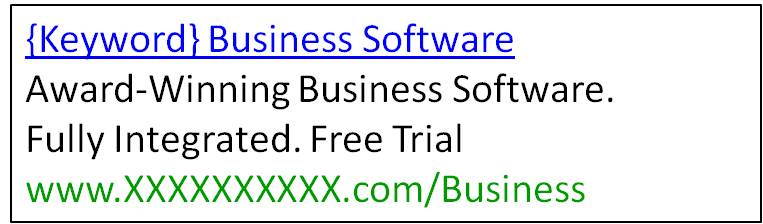
PPCThe original ad used mainly vague qualitative statements (e.g., “award-winning,” “business software,” “fully integrated”) throughout, giving the ad little distinction from others.

Of course, there are limited characters within a PPC ad and it can be difficult to include deep specifics for certain claims and offers. But, as we will see from this test, sometimes it pays to get creative with our ad copy.

The new PPC ad

PPC 2For the test, we were able to fit a bit more specific language on the second line of this ad. We included exact figures that underscored the popularity of this software. They have more than 6,459 current customers and their software is the top used by businesses.

It is important to note that, though “award-winning” could be expounded and specified, we had to balance the information we wanted to include in the ad with the amount of characters available. So we made sure that “award-winning” was explained immediately on the landing page customers reach by clicking on this ad.

The results

Overall we saw the click-through for the new ad increase 20.9% with no significant increase to the cost-per-click. For such a crowded market, an increase like this is nothing to turn your nose up at. This PPC was just one part of a holistic optimization strategy that, in the end, decreased the cost-per-acquisition by 66.4% and increased revenue by 267.9%.

So what’s does this mean for you?

This test underscores two key principles that we should all walk away with:

  • First is the value of SPECIFICITY. Using clear statements provides a greater value perception in the mind of the user. If we want our PPC ads to stand out, we ought to use quantitative statements instead of (the much more common) qualitative claims. It’s a simple strategy, but it can have a significant impact on our efforts.
  • Second is the importance of STRATEGY. This takes the complete picture to see clearly, but small gains are more powerful as part of a holistic optimization strategy. This 21% increase would be multiplied tenfold at the end of the day after we had optimized each step in the conversion funnel of this offer. So, when possible, test holistically.

Dr Flint McGlaughlin will be talking more about this second principle on today’s web clinic, as he walks through the entirety of this case study from PPC ad to the form submission page. He will explain in more detail how this company’s testing strategy took a 21% gain and multiplied it tenfold.

Related Resources

Compounding ROI of Sequential Conversion Rate Increases: How one company took a small gain and multiplied it tenfold

PPC Innovation: How will Google’s new lead capture extension affect your pay-per-click campaigns?

Face Your Fears: Why visitors really bounce from your site, part 2

Paid Search Marketing (PPC), Research Topics

Corey Trent

PPC Innovation: How will Google’s new lead capture extension affect your pay-per-click campaigns?

Corey Trent March 29th, 2010

We have been quite busy at the labs here, but I wanted to cover a PPC development that blipped on our radar earlier this year. For many of us, PPC is a critical source of traffic, and can be quite the task to manage. Well to add to the list of things to consider, Google is beta-testing the collection of phone lead information directly from SERPs (Search Engine Results Pages).

Google generates roughly 97% of its revenue from online advertising, so it makes sense that they delve into new areas of online marketing – which now seems to include part of the sales process as well.

Given the huge potential (or threat) this represents to you, the Internet marketer, I think this is a vital development to cover on this blog (and even reached out to a search engine marketing firm to get their ideas for you as well.) While this will not affect all verticals, for some niches this might pour some gasoline (or more correctly napalm), on already very competitive areas.

So how does it work?

According to Amber from PPC Hero, “The gist of the beta is if you’re running a PPC ad in Google, and you’re in the top position, you can click on a plus sign next to a call to action (the name you give your contact form) and Google will drop down your contact form to be submitted right there in the Google search results.”

Here is an image from that article to show the lead collection:

Google-contact-form-beta

It’s important to note that, as with all things in beta, this has the potential for change, as I believe Google does do some testing from time to time.

And since this new feature is currently in beta, limited to businesses appearing in position #1 of PPC results, and on select keywords, it may not be available to you yet. If you’re interested, the best person to contact is your friendly Google rep.

More importantly…how can I make it work for me?

While I think this could have potentially large ripples in certain areas of online marketing, I wanted to have a chat with our friends at ROI Revolution, and get another viewpoint as well.

As a quick background, ROIRevelution is a company whose main area of focus is in pay-per-click management and they are quite good at it. We had the chance to speak with PPC Account Manager Mike O’Rourke. Here are just a couple of points Mike and I discussed:

Upsides

  • Simplifies the conversion process.
  • No friction (and lead loss) from weak landing pages.
  • Great tracking for businesses that use the phone a lot, a traditional weakness of current PPC tracking solutions.  Interesting, how could this be applied to other voice communication/VOIP solutions like Google Voice?
  • The feature will be good for certain verticals (e.g., plumbers) that provide local services tied to specific keywords (e.g., “broken pipes”).

Downsides

  • Can’t have a conversation in a PPC ad. Landing pages provide a good service for addressing anxiety and questions. So how effective will this lead capture be?
  • Opportunities to increase the value of a lead with a well-optimized funnel are lost (e.g. upsells). Without the ability to do that how valuable will the leads really will be?
  • Because conversion is expected on the search page, you do not have their undivided attention.  On a landing page, you can guide their thinking.
  • Maximum cost-per-click (CPC) rates are applied to leads submitted. This will likely cause your cost per acquisition to rise.
  • Since you must in position #1, the bids for the top position might heat up significantly.
  • Many people also now use many CRM solutions for keeping track of customers and sales. Will this information be easily integrated with common solutions or sent to advertisers in a standardized way?

Won’t you tell me your name? I love you. Hello.

Personally, I am interested in seeing are how users respond to putting their information directly into a form on a search engine results page. While I think some users are very trusting, others might be turned off by your attempt to get their number so soon.

It might seem like an out-of-sequence conversation. As Flint McGlaughlin, the director of MECLabs Group (our parent company) describes trying to ask for a lead to early in the process, “You don’t ask a girl for a kiss before you have a date with her.”

That might seem kind of corny. But think about how you handle your own phone number. Many of us treasure our phone numbers and can guard them quite fiercely. Will a relatively short ad space be enough to capture users and convince them to give up this information? Are you asking for too much, too soon?

Also, some of the things we talk about in great detail here are anxiety and value proposition. While you can address these with your ad copy in a limited fashion, the fact remains you only have so many characters to work within.

Your pay-per-click ad copy and the space search providers give you is simply to get the conversation going – address why they should click, how you are meeting their motivation, and then get them to a landing page to do the heavy lifting.

In skipping that step, you can end up with spending a lot of money (especially by paying max CPC) with leads that are not as qualified or do not convert.

Also, since this is a new technology, you might be getting a fair amount of people using it because they wanted to see how it works, rather than being genuinely interested in your message.

I have some more thoughts on this that we will post soon, but I want to get your opinion on what impact, if any, you think this new Google innovation will have?

Great tracking for businesses that use the phone a lot, a traditional weakness of current PPC tracking solutions.  How could this be applied to other voice communication/VOIP solutions like Google Voice?

Paid Search Marketing (PPC), Research Topics

Boris Grinkot

Translate Holidays into Dollars: How to Structure Your Offer’s Metamorphosis

Boris Grinkot November 30th, 2009

Why is the holiday shopping season so great? Your customer has an immutable purchasing deadline. Her fifth-grade, Wii-craving son won’t let her forget it, and neither should you. But as…tick, tick, tick…precious time passes in the make-or-break shopping season, are you flexible enough to take advantage of this natural urgency factor to get the greatest ROI out of your traffic?

In the September 22 Web clinic, our special guest Linda Bustos mentioned the idea of how online retailers may want to shift their focus from regular shipping of physical products to more holiday-conscious messaging, eventually moving toward downloadable products when the time runs short. I thought that this point deserved a deeper look.

Natural Urgency: An Opportunity for Increased Relevance
The holidays are a goldmine because you have extra insight into what your customers want, and when they want it. I will use the example of Christmas in the rest of this post (because it’s the single most commercially impactful holiday in the world), but the same principles apply to other holidays or even to specialty products and services that exist in relation to a specific “deadline” that the customer has to meet, like a wedding, a housewarming party, or one of your aunt’s cats’ birthday. When you know that urgency is a factor in your customer’s decision whether to buy from you, it is critical that you help this customer not only understand why your offer is the best choice, but also how you can deliver it on time. Providing this helpful information will help your customer buy from you.

The underlying principle here is that you must use everything you know about your customers (and every interaction they have with your site tells you something) to present your offer in the most meaningful, relevant way. For example, knowing what holidays are coming up within the next few weeks, you may want to test links to “Christmas gift shopping” on your site. While your catalog of products will not change, you know that anyone that clicked on that link is looking for a Christmas gift, and now you have a date to work with. You can test letting your visitor choose the target holiday, or if you have the data to assume that your customers are predominantly Christmas gift shoppers, your site by default can address that particular holiday.

December 1: Make your site holiday conscious
Just twenty-five shopping days until Christmas. If you’re in B2C ecommerce, you probably know this number by heart. Share this sense of urgency with your customers, remind them about the last time they had to do last-minute shopping, and communicate the sense of content that results from knowing that you don’t have to worry about making it to the store after work when the gifts are being safely shipped and delivered.

Of course, the critical number that matters online during holidays has to do not with shopping… but with shipping. Make sure your shipping cutoffs are crystal clear on your site. “For guaranteed delivery by Christmas, you must purchase by…” If you fail to communicate this information, your customer will look for someone that does. Don’t expect your customers to dig through your “Terms” pages to figure this out. “Unsupervised thinking” on your pages is especially lethal and especially inexcusable when you know that there is specific information that your customer needs to make a purchasing decision.

December 15: Reflect urgency using clear delivery options
As you get closer to shipping deadlines, you may want to amplify the message that shipping costs will soon increase, and that the customer will save money by purchasing today. Not only does this help create a reasonable sense of urgency for your customers, perhaps it will also remind you to figure out what a Bakugan is before you end up arm wrestling another guy wearing a “World’s Greatest Uncle” t-shirt for one at the toy store on Christmas Eve.

December 19: Increase emphasis on alternative shopping options
You will reach a point where guaranteed delivery by Christmas is still possible, yet increasingly or even prohibitively expensive. If you have a brick-and-mortar companion store, now is the time to use that to your advantage. You can emphasize how customers can save money on shipping by ordering online and simply picking up at the store. Make sure you communicate how easy the pickup process is and the advantage of not having to fight through the maddening crowd of shoppers. You may consider an express pick-up line at the store, and if you have one, emphasize its additional convenience on your site. You can also offer a better price or holiday-specific bonus item for buying online (which would allow you to collect payment immediately) instead of at the store.

If you don’t have physical locations, proceed directly to the next recommendation…

December 24: Prominently feature electronic-delivery items
By now, the children are all nestled snug in their beds, and all the gifts are tucked under the tree… Or are they? Your target customer just might be pulling his hair out, trying to figure out a last-minute gift. Here is where an ecommerce site can be a huge advantage by creating a digital offering that last-minute customers can buy… even as the clock approaches midnight.

Christmas ChildrenThese could be either all-digital products, like streaming or downloadable audio, an online brokerage account, or a gift card, or you may have to get creative and craft an offer that combines digital and physical components, such as an instantly downloadable cookbook that goes with cookware that will be delivered after the holidays.

An important aspect of digital products is presentation. Especially in the case of gift cards (even the physical version isn’t much to look at), you need to help your customer create a sense of giving a “real” gift. That is, help your customer out and don’t make it look like he has forgotten to buy a gift for his mother-in-law for the third year in a row.

Perhaps you can make an attractive, customizable PDF that the customer can print out to give the digital gift a physical nature. Communicating the benefit of giving (remember, your value proposition here is in part what the giver will feel) such a digital gift may take some education as well. Again, do not rely on unsupervised thinking. Don’t expect that it’s obvious to your customer that printing out a gift card document (really, its only function is to have a record of a coupon code) and putting it into an envelope will put them right back on the “favorite nephew” list. You could test communicating this by showing an image of someone giving this virtual gift to a delighted recipient.

The bottom-line is – it must seem substantial enough that the customer doesn’t feel self-conscious about giving it in person. If the gift is for a long-distance recipient, perhaps you could use video or Flash to make a customizable, attractive gift.

This is a great opportunity for nonprofits and charities as well. Consider buying paid search ads with keywords such as “last-minute gifts” on the 24th and 25th. Create a virtual gift that embodies the power of your charitable mission – perhaps an ebook of stories from people that have been helped or a virtual gift card so the recipient can choose where the donation is spent.

Above all, make it seem like a real, worthwhile gift that anyone would be happy to receive. Even with all-digital gifts, you can give your customer the option (perhaps for a small additional fee) to have a physical document mailed to them later, so that the digital gift will feel a little less digital (and, again, clearly state that “you will be receiving an official copy of your donation certificate…”).

Beyond December 25
Obviously, the above recommendations are ideas on how you can make best use of timing to play up a sense of urgency for a universal deadline. Except, it’s not universal. There are many other dates to keep track of this time of year. Hanukkah begins at sundown, Friday, December 11th. Military families often face much earlier shipping deadlines for guaranteed Christmas delivery to deployed family members. As do those shipping internationally in general.
Use the power of Internet marketing to serve these segments as well. Buy paid search ads with keywords relevant to these customers, and make sure you link those ads to relevant pages that focus on the dates important to them (don’t display your countdown to Christmas for customers that searched for “Hanukkah gift ideas”).

Sometime in January
Now that you’ve had time to recover and learned what a Bakugan is, take a look at your metrics. How much did the metamorphosis of your offer from regular shipped products to driving customers to a physical location to selling an all-digital gift improve your ROI? Whether it was a banner season or a disappointing season, make sure you learn what works best for your site and use that information next year.

As always, the ideas above are meant to be tested, and we hope that you will share some of your interesting test results with us.

Daniel Burstein contributed to this blog post…and hopes Boris goes wassailing around the office with his guitar for the holidays.

To listen to Boris Grinkot’s last-minute holiday tactics to increase revenue from your house email list, join us this Wednesday for our next free web clinic – Optimize your Email in Three Steps: How one marketer tripled revenue from their house list.

Ecommerce, Practical Application, Research Topics

Corey Trent

Face Your Fears: Why visitors really bounce from your site, part 2

Corey Trent November 23rd, 2009

In Part 1 of our series on bounce rates, we explored how to drill down into your metrics to find the numbers that really matter. But that left us with an unsettling question. For the users that do bounce but shouldn’t…what is missing that would pull them into your site?

Look at where your traffic is coming from and where it is landing
Many people think that a high bounce rate means there is a problem strictly with the content on the page. While that can be the case in part, you should take a step back and look at where people are coming from and the messages they see before arriving to your site to fully diagnosis a high bounce rate. For example, let’s look at the following user interaction…I’ll be the guinea pig.

I’m thinking of buying a new turbocharger for the Subaru WRX I race on the weekends. So I search for turbochargers.

Google Search "turbochargers"

Then I click on a PPC ad that mentions the following items:

  • Unbeatable prices
  • Turbochargers in stock
  • Free shipping

I think to myself, “Great! This is exactly that I am looking for.” I initiate a click and this is the page I am greeted with:

Xtreme PSI

Where is free shipping?
Where are the in-stock items?

And most importantly… WHERE ARE THE TURBOCHARGERS?!

If you just looked at the content of the site in a vacuum, you would find it acceptable. But users being directed to this site from that PPC ad have expectations that this page isn’t fulfilling.

I have seen many people in this situation look at their site metrics and when they see the high-bounce rate, just keep radically changing the page without any real regard to the user’s thought sequence. They get frustrated when the page continues to underperform.

And remember, I am just using my quest to break the local time trial record in my tuned-up WRX as an example. These principles do not only apply to landing pages or companies running paid traffic.

Text links (on other sites directing traffic to your pages), emails, and newsletters set just as much expectation as paid search banners. For external links, use a research tool like Yahoo Site Explorer to investigate the links to your pages along with the messages being communicated. Then evaluate if your page connects with those messages (If you’re uncomfortable with how your page is presented, contact the owner of the page to edit the links. You will be surprised how willing people are to make those edits if you ask nicely.)

Of course, giving customers the information they need is only the beginning. If we really want to address the bounce rates of key segments we are concerned about, we must get them to act…

On Wednesday, Part 3 will examine how you get visitors to act by giving them a clear path for what to do next.

Have additional questions? Other metrics you’d like to look at? Use the comments section below or shoot me a tweet me at: @ctrentmarketing

Analytics & Testing, Internet Marketing Strategy, Paid Search Marketing (PPC), Research Topics

Clinic notes: Ecommerce holiday playbook wrap-up

Linda Bustos October 1st, 2009

Editor’s note: Anyone involved in eretailing should know ecommerce analyst Linda Bustos. The driving force behind the award-winning GetElastic blog, Linda is also a MarketingExperiments certified optimization professional and knows our methodology inside-out. So we were delighted to have Linda as a featured guest on our ecommerce clinic and now on our blog, with her wrap-up and takeaway tactics from the session.

Just as shoppers often wait until the last minute to finish their holiday shopping, often online retailers find themselves behind on their holiday optimization.

Procrastinators need to implement ideas that don’t involve long lead times for design, development or approvals. In the Ecommerce Holiday Playbook for Procrastinators web clinic, we shared tips and tactics that online retailers can implement in as little as five minutes to make the most out of the “most wonderful (selling) time of the year.”

The 5 areas covered were:

  • SEM (Search engine optimization and paid search)
  • Shopping engines
  • Email
  • Landing pages
  • Post-holiday (ring in the New Year!)


1. Search Engine Marketing

  • SEO: Add value propositions in meta descriptions and page title tags to increase clickthroughs

using value propositions in SEO tags

If you’re familiar with the MarketingExperiments Conversion Sequence, you’re well versed in the importance of value propositions. They are the key to success in any optimization effort. Are you leveraging your value propositions at every marketing touch point?

If it’s true that 80% of web sales begin with a search engine query, it’s important that you sell yourself in your search listings, whether they be organic results or pay per click. Are you communicating why someone should click on your link, instead of anyone else’s? What is it about your store that is unique?

Make sure searchers can see in your title tags and your meta descriptions what it is that makes shopping with you the best choice.

  • PPC: Bid on relevant holiday keywords, such as …

holiday-keyword-ideas

People are not just searching for products, they are searching for ideas. It’s quick and easy to set up a holiday Ad Group or groups targeted to gifts and gift ideas for different holidays and recipients. Then flip the switch December 26th for after-Christmas sales. Last year Google Trends, which tracks the most popular searches of the day, exploded with searches for after Christmas sales.


2. Shopping Engines

  • Add free shipping, value proposition
  • Plan for increased bids during holiday period
  • Know when to turn down your bids (after shipping cutoff)
  • Sanity check data-feed accuracy
  • Pull non-holiday categories if budget is a concern

We know that shoppers use search engines to hunt for gifts, and often their searches direct them to a comparison shopping engine like Google Products, Shop.com, BizRate, PriceGrabber etc. Shopping Engine Optimization is the “other other” SEO, and is also called Data Feed Optimization.

Data feeds are the way merchants provide their catalog information to these sites, and the information you include in your data feeds may vary from engine to engine. Some engines allow you to add shipping offers or other value propositions in extra fields. So it’s important that your feeds are tailored to each engine and really take advantage of your options.

On the strategic side, you should also be planning for increased bids to remain competitive. Holiday click prices are often higher than the rest of the year. While you don’t have to increase bids, depending on what other retailers are doing you may have to to keep appearing high enough in results, and it also provides you with a slight advantage if your competitors don’t turn up their bids.

Don’t forget to turn down your bids after your shipping cutoff date. This is different for every retailer, so make sure you have a process to do this.

And make sure your data feeds are accurate – that you’re not listing out of stock product, pre-orders, backorders and non-holiday items, especially when you’re working with a set budget and you’re spending more per click. It may make sense to remove categories that are typically not gifted to others (like computer cables if you’re an electronics store) temporarily for the holiday season.


3. Email

Stress the benefits of online shopping in your subject lines, including:

  • Save time
  • Save gas
  • Avoid lines
  • More selection
  • Hard to find items
  • Gift finder tools

Some of my favorite examples from last year are (emphasis mine):

Easy-to-Make Holiday Cards. We’ll Mail Them.
Avoid the Rush! Get Your Gifts Now, Save $15 & Pay NO Shipping!
Avoid the crowds – Shop from Home and get Free Shipping
The Gift Guide Is Here: The Best Gifts at Even Better Prices
Email Exclusive Free Shipping, No Threshold. Today Only!

Holiday time is both great and gruesome for sending retail email. On one hand, when you deploy retail email you hope that the recipient is interested in shopping that week. During the holidays, you’re nearly guaranteed that he or she is. However, you are also competing for attention against any other retailer that the subscriber has opted in to.

Like Dr. Flint McGlaughlin says, the goal of the email is not to sell but to generate interest in visiting your site. The offer and the creative is important here, but before one sees your email message, they must be persuaded to open your message. Subject lines matter!

Remember that we as ecommerce marketers want customers to use the online channel to shop. It’s great if you have local stores that may still benefit from your demand generation, and converting online can be attributed back to which campaign and email version referred the visit. This gives you better insight into what is and isn’t working. So may I suggest that you really communicate the benefits of shopping online, as well as shopping from you. The above examples do that.


4. Landing Pages

Address the FUDs (Fears, Uncertainties and Doubts, or, Anxiety)

  • Clear link to gift guide (create new category if needed)
  • Clear link to store locator
  • Clear shipping cutoff link
  • Shipping policies, return policies, countries ship to
  • Customer service number (every page is a landing page)
  • Promote e-gift cards (never too late!)

Just as important as driving traffic is having an optimized website prepared to convert it.

If you already have a gift guide feature, make sure you’re flaunting it — not just in navigation as a text link that blends in with the rest of the links, but clearly on your homepage and on product/landing pages.

Have a clear link to your store locator if you have offline stores. It’s fine to have it subtle the rest of the year in the header or footer menu, but around the holidays – especially after your shipping cutoff date — this deserves more prominence.

Customers want to know what your hours of operation are and even telephone numbers, so make sure that info is on your store locator page.

Shipping cutoff information is also very important. Many retailers do put this information front and center on the homepage. I recommend you show it on every page, because every page is a potential landing page. Don’t assume everyone starts at the homepage and absorbs your messaging and remembers all your details (research shows that’s often not the case).

Ditto for links to return policies and shipping policies, including countries you ship to. Even if your shopper is in the US, they may be shipping overseas.

Don’t forget customer service numbers on every page of your site and every step of the checkout process.

And if you do offer electronic gift cards which can be sent instantly, this is important to showcase – especially after your shipping cutoff.


5. Post-holiday

Post shipping cutoff strategies include promoting gift cards, any in-store pick up options and even gift notifications sent immediately to gift recipients, letting them know they weren’t forgotten but that their gift may arrive a bit after the holiday.

For example, Upresent.com is a service for merchants to offer such messages.

Last holiday, Musician’s Friend offered a $20 comeback coupon for the gift buyer, which is a great incentive to come back and purchase again during the typically slow month of January.

Finally, though we are really close to the holiday, it’s not too late to think about your merchandising for post-holiday. Popular approaches include showcasing items for New Year parties…

…and New Year resolutions – like Drugstore.com’s emphasis on products to help you lose weight, stop smoking, get fit, look your best, go green or be healthy.

For more ecommerce tips, tactics, ideas and research, be sure to visit (and bookmark) the excellent GetElastic blog.

Clinic Notes, Ecommerce, Practical Application

How many ping pong balls are on your landing page?

Pamela Markey August 14th, 2009

We’ve hosted a couple of live optimization clinics in the last month or so, featuring audience-submitted search terms, PPC campaigns and landing pages for analysis and optimization.

I was reviewing the live audience Q&A recently and a comment from frequent clinic attendee Jerry E. caught my eye: “The findings are repetitive. Maybe that is because so many are still doing so many things wrong?”

Jerry is on to something here.

While there are many ways to look at a landing page and an endless combination of elements to be tested, we see a lot of similar problems in the pages we review. Mainly, lack of a strong, clear value proposition and way too much going on with pages (competing objectives, calls to action, the “kitchen sink” approach). And we tend to focus on those same areas because that’s where you can find the biggest impact from testing.

Stake your claimpingpong

Many marketers are afraid of defining the one thing that separates their company or offer from competitors — and putting that stake in the ground. We worry that we’ll alienate some of our visitors and send them to the back button. Keep in mind that your potential customer clicked through to your page because something in your search results or PPC ad caught their attention.

Figure out each page’s value proposition and stick with it on the page, as well as in the corresponding PPC ad and search results. If we try to be everything to everyone, we end up being nothing to anyone. Specificity converts.

Choose one ball

Another issue we see often is way too much content on a page, and it’s not unique to landing pages. It’s a big problem in traditional advertising too, and it reminds me of Rethink Communication’s Ping Pong Ball Theory: If I throw one ping pong ball at you, you will probably catch it. If I throw five ping pong balls at once, you probably wouldn’t catch any of them.

It’s the same thing when several marketing and advertising messages are thrown at you all at once. Most landing pages we see have more ping pong balls than any visitor can catch. You are far more likely to absorb the most important message if it’s the only thing coming at you.

This may seem simplistic, but it’s something we all encounter so regularly it’s worth reminding ourselves when we’re at work on our own sites and campaigns. For each page, pick your ping pong ball carefully, and throw just that one.

Clinic Notes, Marketing Insights, Marketing Q&A