Archive

Posts Tagged ‘web clinic’

Web Usability: When should you avoid navigation?

April 15th, 2013 1 comment

Navigation is often considered a core element of website usability.

If you routinely put navigation on every single page of your website, you will likely be shocked by one of our recent discoveries …


You can watch the full free Web clinic – “The Usability Myth: 4 surprising discoveries we learned after testing the most common usability principles” – to hear Flint McGlaughlin, Managing Director, MECLABS, explain three other surprising findings from our optimization testing and experimentation.

Our goal is show marketers key principles that can be used as a framework to aid usability and optimization efforts.

Read more…

Paid Search Marketing: A/B split test produces 144% increase in total leads

April 3rd, 2013 2 comments

Testing and optimizing elements of your PPC ad campaigns can significantly increase conversion when done strategically.

So, in today’s MarketingExperiments blog post, we’re going to look at how the MECLABS Research team used paid search keywords strategically placed on a landing page to achieve a 144% increase in total leads.

First, let’s take a quick look at the research notes on the experiment …

Background: Provides end-to-end market solutions for small and medium-sized businesses

Goal: Increase the email capture rate of an online form

Primary Research Question: Which page will obtain the most form submissions?

Approach: A/B split test


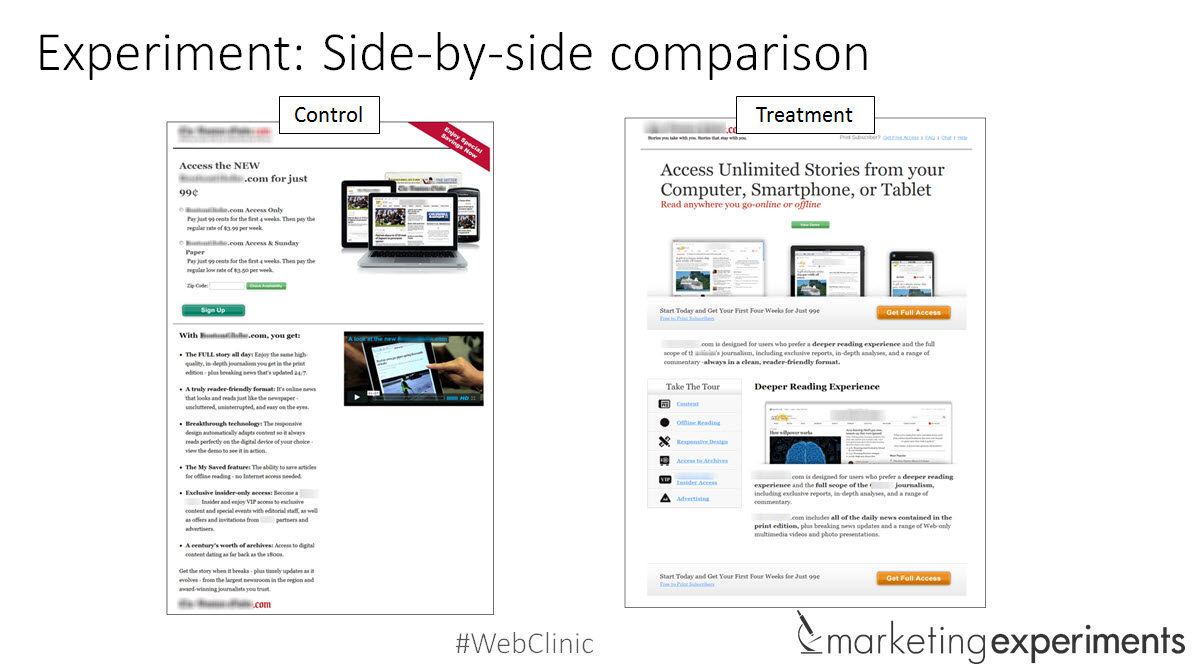
Control 


A problem the team identified in the control was the landing page utilized a general headline that did not reference the keyword used in the PPC ad.


Treatment  


For the treatment, the team hypothesized a simple integration of the keyword utilized in the PPC ad would make a deeper connection between the expectations created by the PPC ad and expectations for the landing page in the mind of a user.

Read more…

Marketing Questions: Making claims for new products, e-commerce landing pages

March 25th, 2013 No comments

During our most recent Web clinic – “Converting PPC Traffic: How strategic keyword placement increased conversion by 144%” – we received questions from the audience that we didn’t have time to address during the presentation. So, let’s take a look at them now …


If you have a new product, you can’t make those kinds of claims – then what do you recommend we do? – RD

I believe RD’s question is in response to two discoveries we often teach.

One, specificity converts. “In marketing there should be no such thing as a general message,” said Flint McGlaughlin, Managing Director, MECLABS. “The marketer communicates with an aim. This aim should dictate everything else we say. This aim should influence, even constrain, every word we say.”

Second, third-party credibility indicators can help you achieve that specificity. A nice example, from this blog post about homepage optimization, is “2 million success stories and counting,” with logos of satisfied customers.

This is a significant challenge for a new product. So, here are some ideas to get you thinking:

  • If it is a new product from an established company, you can test third-party credibility indicators for other products your company creates.For example, when we launched Optimization Summit a few years ago, we used testimonials about other MECLABS events. If we did not have other MECLABS events, perhaps we would have used testimonials of other types of MECLABS comment, for example, a MarketingExperiments Web clinic. After all, if your company creates a similar product of high quality, it is a fair comparison the new product will be of high quality as well.
  • If it is a new product from a new company, you can test third-party credibility indicators based on the experience of the company founders or employees.

For example, let’s say your product is software. “The team behind software X has produced 37 programs rated five-stars by CREDIBLE SOURCE HERE” might be a worthwhile message to test on your landing page.

Overall, these are short-term solutions. You want to put systems in place to garner third-party credibility indicators with as much specific information as possible. If you’re not sure where to begin, this MarketingSherpa case study about how a bathroom supply e-commerce site used a sweepstakes to encourage customers to submit product reviews might be helpful to you.

Read more…

A/B Testing: Changing 3 words results in 43% increase in funded accounts

January 9th, 2013 2 comments

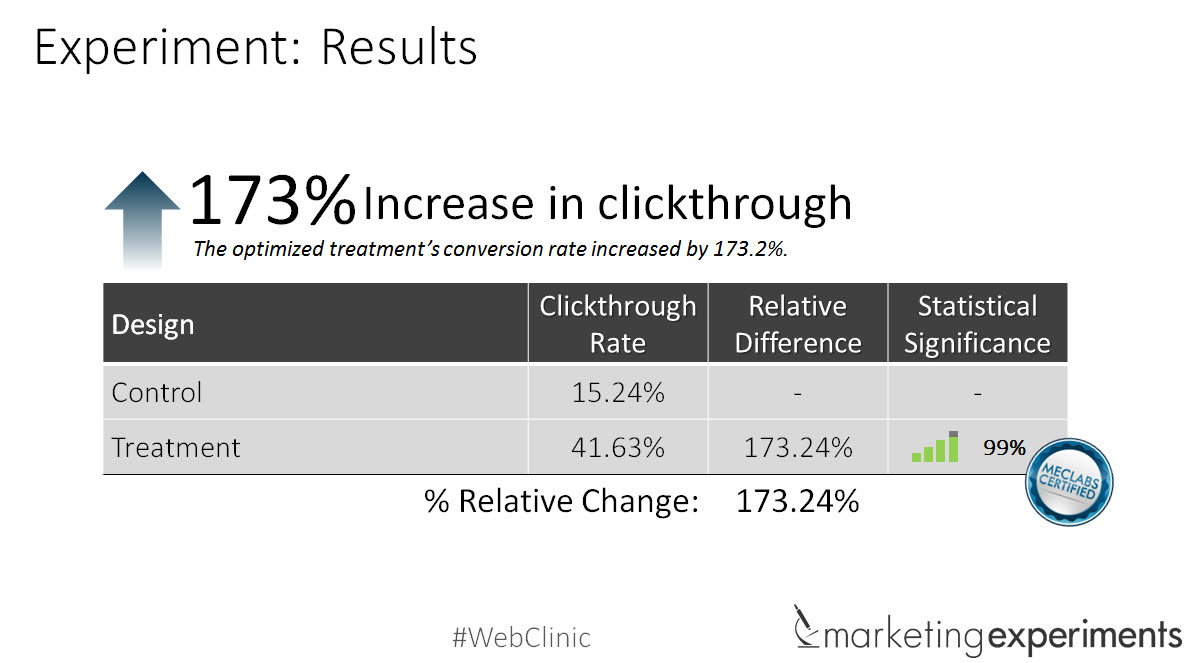
A recent MarketingExperiments Web clinic featured the following experiment …

Background: This test was implemented in the secure section of a large financial institution’s website. The offer was an up-sell for a savings account.

Goal: To increase approved and funded savings accounts

Primary Research Question: Which link copy will result in the highest impression to funded account rate?

Approach: A/B Single Factor Split


CONTROL

Here is the original conversion path …


Read more…

Marketing Career: Free resources from MECLABS to help you do your job better

August 8th, 2012 2 comments

Usually on the MarketingExperiments blog, we take a deep look at a specific topic, such as factors for choosing online testing and optimization platforms and landing page optimization. After all, our job is to help you do your job better. (Let us know how we can help.)

But, in today’s post, I want to take a step back from those granular topics, and to help you understand all of the free resources available to you through MECLABS, the parent company of MarketingExperiments.

If you’re unfamiliar with MECLABS, you can download the 403-page MECLABS Research Catalog for a look at the scope of our research and reporting. We make all of this information available to you through these free resources:

Read more…

Test Your Marketing Intuition: Which call-to-action won?

February 22nd, 2012 15 comments

“There are no expert marketers; there are only experienced marketers and expert testers.” – Dr. Flint McGlaughlin

Once upon a time, marketers could claim they knew what marketing collateral would generate the highest response from the customer. Now, with the advent of online testing, it has become more challenging to “make definite assertions” about which treatment will perform better.

The best we can do is pose  a hypothesis.

Of course, it never hurts when your hypothesis turns out to be absolutely right.

So to give you a 50/50 chance at gloating (even over a lucky guess), you can hypothesize which call-to-action performed better in the slides below.

Once you’ve studied the slides, go ahead a leave your hypothesis for which call-to-action won (and why) in the comments.

The commenter with the best hypothesis will get the recognition of his or her peers and be featured in the body of this post with a link to their site.

Here is the test we will highlight in today’s 4:00 p.m. (EST) Web clinic: Minor Changes, Major Lifts: How headline and call-to-action optimization increased conversion 45%.


Read more…