




If you’re looking for ROI gains and you’re not sure what areas to test first, start with headlines or subject lines.
The impact of headlines on conversions is no secret, but the ease of testing (no design, coding, etc.) makes them even more valuable.
Caveat: Creating and testing effective headlines can be deceptively simple. There’s much more to them than slapping a catchy subject line on an email blast, or cramming keywords into PPC ads.
The real challenge lies not only in crafting successful headlines, but using them to conduct effective tests.
The research brief below, drawn from our free Web Clinic on August 27, 2008, explores the objective and key qualities of successful headlines, presents case studies and examples of strong and weak headlines, and offers step-by-step methods you can use to test and optimize your own headlines.
The “Secret” of Compelling Headlines
In the volumes of information and how-to guidance on writing strong headlines, one fundamental principle is too often overlooked.
The objective of your headline is not to sell, but to connect with your reader.
It’s easy to lose sight of this objective with headlines especially when marketers and copywriters are under intense pressure to increase revenue. There are so many competing messages, and just a handful of words to work with in PPC ads, email subject lines, press releases, and landing page headlines, that the temptation to produce headlines that “sizzle” can be irresistible.
But that approach is increasingly shunned (or deleted) by post-modern consumers, who are inundated with more than 600 marketing messages per week, have less time to read than ever before, and are deeply skeptical about sales and marketing pitches as it is.
When we’re focused on the end result, we tend to ask headlines to do too much and run the risk of overshooting the mark. On the other hand, twisting our headline copy to placate search engines and spam filters can lead to keyword-laden, uninteresting language.
Think of your headline as the first step in a process:
- The headline draws your reader into the next line (subhead).
- The subhead connects them to the first paragraph (copy).
- The first paragraph engages them with your offer.
Let’s look at some examples of how different headline styles can be tested and used effectively in this way.
Case Study #1 (PPC Ad): Statement or Question?
We conducted a test with a research partner to increase the clickthrough rate of a pay-per-click campaign.
Our primary research question: Which headline style performs better,
a statement or a question?
This test split traffic evenly across a PPC ad group with four iterations: one question-style headline, and three statement-style headlines.
For this case study, we will focus on the two ads from this group that performed best.
Search keywords: free content

[Editor’s Note: To increase ad relevance in the treatments, the end of the second line of copy (after “your site &”) retained the format of the control but was matched to the headline.]
Results
| Landing Page | Clickthrough Rate |
|---|---|
| Control |
2.71%
|
| Treatment |
1.99%
|
| Relative Difference: |
36.18%
|
What you need to understand: The control ad (question style) outperformed the treatment ad by 36.18% in clickthrough rate.
Case Study #2 (Landing Page): Headline or Design?
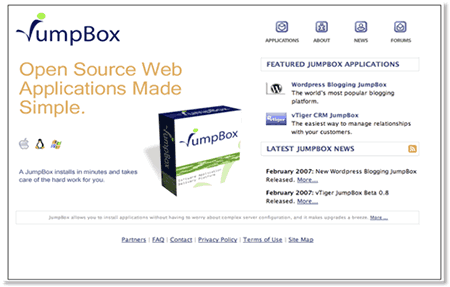
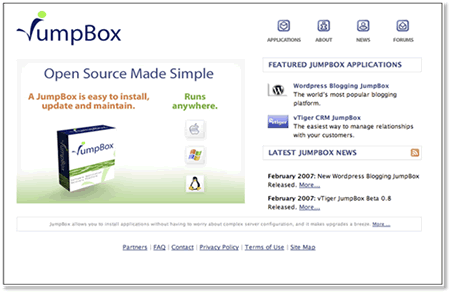
Sean Tierney of JumpBox, Inc. conducted a series of A/B tests to improve conversions of a PPC landing page.
The vast majority of the page retained the same design and copy. Headline and subhead changes were the most significant factor.
For this case study, we will examine the control and the final test version of the landing page.
Control Landing Page
Treatment Landing Page
Side-By-Side Comparison of Versions

Results
| Landing Page | Conversion Rate |
|---|---|
| Control |
11.3%
|
| Treatment |
21.2%
|
| Relative Difference: |
87.61%
|
What you need to understand: The redesigned landing page outperformed the control by 87.61% in conversion rate.
According to Sean Tierney, who conducted the tests, “The biggest thing I learned from those trials was that for all the debate we had over which design was better, ultimately design was completely eclipsed in importance by clarity/brevity of the messaging. Reducing [the headline] from six words to four doubled the effectiveness of the page.”
[Editor’s Note: This case study was also published in the MarketingSherpa Landing Page Handbook.]
Case Study #3 (Email): Which Style Works Best?
We conducted a split test of three email subject lines using the invitation for this clinic.
Primary research question: Which subject line would achieve the highest open rate?
Secondary research question: Which subject line would achieve the highest clickthrough rate?
Approach: This A/B/C test went to three groups. Subject line A used our standard language style and format. Versions B and C tested different angles. Body copy was the same for all three emails.
Subject lines tested:
A: Web Clinic Invitation: Do headlines really increase conversions? (8/27)
B: Next Web Clinic: Optimizing headlines to improve your conversions
C: Headline optimization small changes that can boost conversions
Other questions we considered for the test:
- Impact of the front-end introductory text (“Web Clinic”) vs. the topic-only style.
- Impact of time indicators (clinic date, use of “next”).
Results
| Subject Line | Opens% | Clicks% |
|---|---|---|
| A) Web Clinic Invitation: Do headlines really increase conversions? (8/27) |
11.8%
|
1.8%
|
| B) Next Web Clinic: Optimizing headlines to improve your conversions |
11.9%
|
2.0%
|
| C) Headline optimization small changes that can boost conversions |
12.5%
|
2.0%
|
| Relative Difference (C to A): |
5.9%
|
11.1%
|
What you need to understand: Version C outperformed both Versions in open rate by 5.9% (relative increase), and achieved the highest click rate (tied with Version B) . Also, the clickthrough rate of Version C was 11.1% higher than Version A, the “control” in this test.
Version C was also forwarded 24.2% more often than the other versions.
Three Qualities of Winning Headlines
While several factors can contribute to a headlines success, and there is no single fool-proof formula for a winning headline, there are three qualities that can increase the power and performance of headlines:
- Clarity
- Relevance
- Credibility
When headlines and subject lines apply these three qualities, they are more apt to connect with the reader – which is the true objective.
Here’s an example of a real headline and copy combination that follows the three keys and the principle of connecting with readers. It’s not the most clever or catchy language; however, it is clear, relevant, and uses the supporting information to shore up its claims.
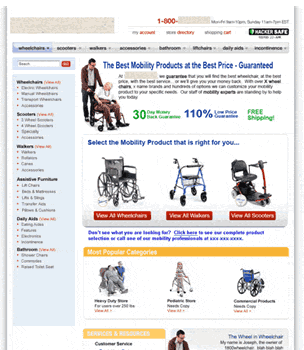
This page illustrates how a headline connects with readers by matching their intentions, pulling them into the content, and then further down the page deeper into the offer:
- Headline on the homepage describes value proposition and the guarantee as a compelling “hook” to continue reading the intro copy and start searching for a product.
- Intro copy re-emphasizes guarantee with additional clarity and in a concise way lets the customers know what the company is about and what they have to offer.
- Picture of person pushing someone in mobility product adds a “personal connection” to the intro copy and draws the customer’s eye to that section.
- Value proposition points are displayed clearly under copy and within the fold.
- Sub headline is a “call to action” instead of a statement like “Finding the right mobility product.”
- Text has been added below the product in case the type of product they are looking for is not listed in this section.
Headline Examples: Strong and Weak
The following examples illustrate the importance of clear, relevant headlines, regardless of whether theyre found on a homepage, PPC ad and landing page, or in natural search engine results.
Homepage headline

Strengths: Direct, concise, specific, newsy. Subhead gives two key benefits.
Page Title (Organic Search Engine Results)

Strengths: Keywords + energy + brand + value proposition, expanded upon in the subhead (description).
Landing Page headline
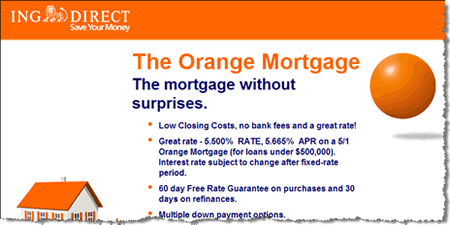
Weaknesses: Informational, lifeless headline relies too heavily on brand recognition and tries to use subhead to allay concerns of anxious target audience.
PPC Ad and Landing Page
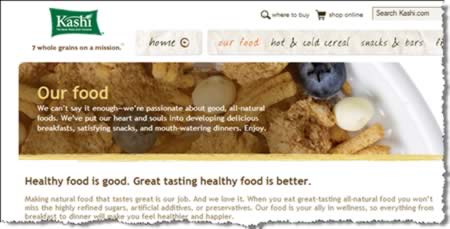
Weaknesses: Branding-based PPC ad title is followed by weak declarative headline hidden in the design and less compelling than subhead. Does not connect with the PPC ad language clearly enough.
Methods for Making Your Headlines Stronger
If you’re willing to invest some extra time and effort to produce stronger headlines, consider the following two approaches. Used separately or in tandem, these methods can improve headlines by providing you with additional perspectives: including “preview” feedback from your target audience.
“Pre-Test” Your Headlines
- For each headline you need, write 10 different headlines using a wide variety of angles.
- Get feedback from colleagues, tweak as needed, and whittle the headlines down to the top three.
- Take a sample from a few top customers or external peers. Ask them to pick their favorite, rate the headlines on a 1 to 5 scale and/or tell you what they did and didn’t like. Do this via email, IM, Twitter or phone – but don’t wear it out.
- Use email to A/B test the top two headlines to a small but valid segment of your list (1,000-2,000 names). Apply the winning headline to the full send, or test again.
“Cross-Test” Your Headlines
- Use PPC, email, site pages, optimized PR to complement each other for testing headlines with different lengths and styles.
- PPC ad titles force you to write short, while email subject lines and site page/article titles allow for longer headlines.
- So cross-pollinate them:
- Insert the strongest words from PPC ads into email.
- Test email subject lines in PPC ad copy lines 1-2 (keeping the title and URL the same to isolate the impact).
- Use headline-style links in online press releases, not “click here” or raw URLs.
- Track clicks on blog links and your site content for clues to language to test in headlines.
- If you’re looking for ROI gains, a variety of headline and subject line test methods can provide a significant impact at minimal cost.
- The objective of a headline is not to sell, but to reach out and connect with the reader, and pull him or her into reading more.
- Three key qualities of successful headlines: clarity, relevance, and credibility.
Related Marketing Experiments Reports
As part of our research, we have prepared a review of the best Internet resources on this topic.
Rating System
These sites were rated for usefulness and clarity, but alas, the rating is purely subjective.
* = Decent | ** = Good | *** = Excellent | **** = Indispensable
Credits:
Managing Editor — Hunter Boyle
Copy Editor — Frank Green
Contributor(s) — Flint McGlaughlin
Aaron Rosenthal
Jimmy Ellis
Bob Kemper
Production — Mel Harris
Austin McCraw
Cliff Rainer
Holly Hicks